Thursday, June 01, 2006
The price of Ignorance
The condition of being uneducated, unaware, or uninformed
dictionary.com
The government spends billions on NEPA or whatever its called now and the power situation has still not improved, (in fact its actually worse than it was 10 years ago). What happened to all the money?
Just like the telecommunication sector (where ex NiTel employees now successfully run Private Telcos after destroying NiTel) , the power situation will never improve in Nigeria until private power companies start operating. (i.e Private power companies run by ex NEPA officials...).
The selfish gene is truly alive in naija
The government introduces a discriminatory sex law, the whole debate is hijacked by people who obviously are so scared of their own sexuality but choose to hide behind their so called religious beliefs. The words of Martin Niemöller comes to mind;
'First they came for the Communists, and I didn't speak up,
because I wasn't a Communist.
Then they came for the Jews, and I didn't speak up,
because I wasn't a Jew.
Then they came for the Catholics, and I didn't speak up,
because I was a Protestant.
Then they came for me, and by that time there was no one left
to speak up for me.'
It's a slippery slope when government starts regulating morality…
The Lagos state government builds a solar power station (as part of a pilot scheme) for the residents of Bishop Kodji Island.
According to the The Punch Newspaper "Our correspondent who visited the village last Thursday said that the solar panel had been switched off by officials in charge of the project as a result of which the villagers could not enjoy electricity.
It was gathered that the solar panel was switched off because some of the villagers tried to connect electricity from the panel to their homes illegally. This, it was learnt, caused the panel to trip off and the village thrown into darkness."
The Ogun state government repairs a water pumping station that has been out of action for decades, a few weeks later the station is vandalised. The government repairs it and a few weeks later it is vandalised again, this time it can't be repaired.
The people have no water but the owners of water tankers are happy..
Millions of Nigerians are struggling to survive but if you attended an owambe party where people 'spray' dollars or opened a copy of Ovation and saw headlines like 'Chris Uba Hosts The Mother Of All Parties' , You might be forgiven for thinking that everything is well in Nigeria and it is truly the happiest place on earth. (talk about an anomaly - Nigeria tops happiness survey and yet life expectancy is 47, strange indeed...)
Quote: "Power in the hands of an ignorant man, is like a rocket launcher in the custody of a terrorist." - Reuben Abati
Thursday, May 25, 2006
The Rich List
my cousin wrote this email and sent it to me and a couple of his friends, i'm posting it here as it touches on issues that affects all Nigerians/Africans.
---------
To some of you who have been asking me about investment ideas, this is where I get things of my chest. If you are of nervous disposition, this is where you should stop reading.
I read with interest the list of the richest people in the UK, guess what!, not a single African. There was even an Asian list. We know there are several Africans who have looted their national treasuries and are probably as rich as hell, obviously those of ill forgotten funds cannot be counted.
So, to my real reason for writing this, why are we not making money in the UK?.
1) We don't have the capital or the number of people to support our ventures
2) We never come together as there are too many 419ers amongst us. Like the people at home, several of us would rather steal from their friends than work honestly for their money, the result, we don't get anywhere at all.
3) We spend most of our time having great parties, without any plans for the future.
4) Unlike the other groups in the UK, we are completely divided and we will rather do our own little things, which normally gets us no where. If you are one of those ˜buy to let" entrepreneurs, before you start writing to me about how wrong I am, please take a few minutes to consider your options. If you are doing so well why are the banks making record profits?.
For some of you interested in properties, have you tried to buy abandoned or struggling hotels, old schools, a warehouses or public houses for conversion. These are property investments outside the reach of most people, but by coming together you can convert these buildings into apartments. Look at the scenario, a 200 bed former hospital on 80 acres of land, costing £2m, look at the potential when you convert a property like this, with land in short supply, you can convert the property into apartments, and use the land to build on, but you ask me how many people have £2m to burn, definitely not one of us, as individuals, but can you imagine if several of you come together and buy shares in a company, buy the building, renovate, sell some of the apartments, let out others, use the money to convert even more. Amongst us are probably the best brains money can buy, but yet divided we will get nowhere, together though, we are a formidable force.
Unless you can rent rooms in a house, its now difficult to make money from property in the UK.
I know some of you will want to rush off and start on this idea, e-mail me and I will advise you on what to do. I am doing same with a few of my friends, there are enough properties to go round. There are pubs and hotels in distress and there are so many "first time buyers" looking for cheap and affordable houses.
Several of you have attended all the start up business courses on "how to make money from no deposit" property deals. Please spare me the details, if you have money to waste, please continue to attend those courses, if those ideas are so good do you think they will be selling them to you. Can you imagine Richard Bronson or even the Donald Trump trying to tell you how to make money from business or properties?.
Don't even get me going about Franchising, I have analysed so many business plans, your chances of making money on several of them are so slim, the camel and the eye of the needle come to mind.
The only way to make serious money is hard work, nobody will make money and then give it to you. Its just not going to happen, mate. So my advise, get together with people you trust. There is no point in trying to make money by ripping people off, you will end up in jail. There is a lot of money to be made, save well, work together, and most importantly don't get ripped off, even legitimately.
The best business at the moment for Africans is in churches, its legitimate and the church ministers have flashy cars and justify everything about how you need to pay 10% of your earning to support their expensive life styles. The 10% in the bible was before the introduction of the current tax systems.
Your next question to me is why the heck are you doing this?. I hasten to say, I dislike people who take advantage of other people, whether a church minister, a government worker, the plumber who charges £300 for half a day's job or people selling "how to get rich quickly ideas".
If you think I am bitter, of course not. Due to some idiots back in my country, I and several of my country men and women and their children are languishing in strange countries as second class citizens, toiling away for pennies, doing menial jobs and getting insulted in the process. Should I be bitter?, of course not. The generation before mine, looted my inheritance and forced me to work in another country, where less qualified people get better jobs than my country folks because of the colour of their skins, of course I am not bitter, why should I be, our kids are now strangers to their own land and like the Israelites will continue to dream of the land of milk and honey. I don't want any e-mail from you IT consultants, doctors and dentists on £1000 a day telling me how rich you are, but I do want to hear from people who should have been on the rich list i.e worth £60m.
For anybody with Investment ideas, from buying a pub, properties, new business, franchising, tax etc I will analyse it for you, free. You may not like what I tell you, but i will give my honest opinion.
If you or your parents are one of the looters in Nigeria, please don't even try and contact me, it will get my blood boiling, same for 419ers.
My mission in life, is to make sure that we have one genuine African on the list of the 1000th richest people in the UK by 2010, at which point only people with £100m will be eligible. I am just tired of people telling me that if Nigerians are so dynamic, smart and hardworking why are they not on the "bloody list". Roller-skate ready and 4 years to go.
Signed
Ade
----------
Quote: "Money is called currency, because it is designed to flow through you. Money doesn't change you; it only reveals who you truly are." ~ Anon
get involved by sponsoring an African child today:
http://www.plan-uk.org/wherewework/westafrica/
Thursday, May 18, 2006
Hey Abbott Pt 3 (a rejoinder from Ms Abbott)
Ms Abbott responds...
see previous posts
Hey Abbott
Hey Abbott Pt 2
DIANE ABBOTT
Member of Parliament for Hackney North and Stoke Newington
HOUSE OF COMMONS, LONDON SW1A 0AA
24 Answering Service: (020) 7219 3000 Parliamentary Telephone: (020) 7219 4426
E-mail address: drejerc@parliament.uk Parliamentary Facsimile: (020) 7219 4964
18 May 2006
You contacted me about an article I wrote for a Jamaican newspaper about Nigeria. First let me apologise for taking so long to respond. We had local elections in Hackney at the beginning of this month and the campaign took up a great deal of my time.
Obviously I am sorry if my article caused offence. That certainly was not my intention. I realise that the title was quite provocative. But you will appreciate that I am not personally responsible for that.
But I am a little baffled by the response to the article. I wrote it after my second visit to Nigeria in the past six months. In preparation for both those visits I read widely about Nigeria. The issues that I raised in my article were: the fragility of Nigeria's democracy, corruption, religious strife in the North and the tragic situation in the Niger Delta due to oil pollution and the activities of Shell and other oil companies. And I know from my reading and research that these issues have been written about extensively by politicians, academics and journalists. Some of the judgements I have read from serious political scientists have been much harsher on Nigeria than anything in my article. So I could not have expected that, by merely discussing these issues, I would have excited the vitriolic response that I did.
Many people have taken offence at the comparison with Jamaica and speculated as to why I did not mention Jamaica's own serious problems with crime and violence. But the article is just one column from the regular weekly columns that I write for the paper. In other columns I have discussed at length Jamaica's own problems. The comparison with Jamaica was not meant to be slighting to Nigeria, but merely to engage the interest of Jamaican readers.
One of the issues that I raised was the attempt to alter the constitution to allow President Obasanjo to serve a third term. This was raised with me everywhere I went in Nigeria. After all my discussions I came to the conclusion that this would have undermined democracy in Nigeria so I was pleased to see that the Senate has voted the proposal down. But I do not see how it helps those struggling in Nigeria on this, and other human rights issues, to pour abuse on anyone who tries to discuss them.
The most important thing is that I was criticising the Nigerian government and multi-national corporations, I was not attacking the ordinary people of Nigeria.
I am disturbed by how quickly some of my correspondents have assumed that I am anti-Nigerian and responded with an anti-Jamaican diatribe. I have been a political activist in Britain for thirty years. Everybody who knows me understands that the last thing that I am is anti-African.
However I have had some supportive letters from Nigerians. One of them quoted from the great Nigerian writer Chinua Achebe. I will leave you with this quote that comes from his novel "The Trouble with Nigeria"
"Quite clearly, patriotism is not going to be easy or comfortable in a country as badly run as Nigeria is. And this is not made any easier by the fact that no matter how badly a country may be run, there will always be some people whose personal, selfish interests are, in the short term at least, well served by the mismanagement and the social inequities…. Naturally, they will be extremely loud in their adulation of the country and its system and will be anxious to pass themselves off as patriots and to vilify those who disagree with them as troublemakers or even traitors. But doomed is the nation which permits such people to define patriotism for it"
With all best wishes
Diane Abbott MP
-----------------------------
No wonder Ms Abbott is concerned even The Guardian has an article about it and an interesting quote from moi
"Another British Nigerian, in south London, wrote: 'We intend to mobilise and inform Nigerians in her constituency that she only represents the interests of "Jamaicans" and not of other nationalities."
'Think Jamaica is bad? Try Nigeria ... ' How Diane Abbott enraged a community
http://politics.guardian.co.uk/labour/story/0,,1774633,00.html
Quote: "Never be bullied into silence. Never allow yourself to be made a victim. Accept no one's definition of your life; define yourself." ~ Harvey Fierstein
get involved by sponsoring an African child today:
http://www.plan-uk.org/wherewework/westafrica/
Saturday, May 13, 2006
i'm lovin it
I'm talking about Youtube Its like Napster in 99 before it went all 'legal'.
In the last few weeks i've had the opportunity of seeing music videos i haven't seen in years. Shalamar's a night to remember, Kurtis Blow's Basketball, Klymaxx's meeting in the ladies room and Malcolm Mclaren's buffalo girls.
Watching these videos from way back reminds me of how much of a TV addict i was in the 80s. I think i was permanently glued to NTA2 Channel 5 and LWT (Lagos weekend TV, you couldn't touch this station when it came to showing pirated stuff ; ))
I know i'm probably going to come across like an old timer but i have to say the 80s was the best decade ever !!
Friday, May 12, 2006
Interesting Times (in Nigeria)
"May you live in interesting times”
I've been trying to stop myself from blogging about the whole third term brouhaha in Naija. Its not that i'm not concerned about the current events in the country, its just that to be honest i'm just bored, fed up, don't care, don't give a shit etc.
I'm kind of at that point where i'll rather just face the important things in my life than read about the shit happening in naija.
But you couldn't keep me away from naija news, so i had to laugh when i read the news story about the presidency revoking AIT's licence
Presidency revokes AIT's network licence
http://odili.net/news/source/2006/may/10/600.html
Senator Uche Chukwumerije on Tuesday said the Presidency has cancelled the Network Licence of Africa Independent Television (AIT) and has issued a 21-day ultimatum to the television station to vacate its Asokoro office in Abuja.
Addressing reporters at the end of debate on general principles of the amendment of the 1999 Constitution, Chukwumerije, who is Leader of the 2007 Movement said the cancellation is part of efforts to frustrate the ongoing debate in the senate over tenure extension.
He confirmed that an ultimatum had already been given to AIT to vacate its the Abuja office.
Chukwumerije also raised an alarm over a plot to remove Senate President Ken Nnamani over his insistence on following the rules in the course of the on-going debate.
Said Chukwumerije: "The 2007 Movement is outraged by the evident determination of the Presidency to violate all rules, reduce and contract our democratic space in order to get its immediate partisan goal of elongating its tenure of office. In the last two weeks, the Presidency has intensified violation of citizens' rights to freedom of speech and association through three-pronged attacks.
Even Shakespeare couldn't come up with the tragicomedy going on in Naija today. When the likes of Chukwumerije become democrats fighting against dictatorship, you gotta laugh. Unless i'm wrong he used to be IBB's mouthpiece or was it Abacha's, many moons ago. As information minister the guy was a complete joke, even worse than the former iraqi information minister Mohammed Saeed al-Sahaf AKA Comical Ali
but i digress
The issue in naija today is still the same as always, those who want to hold on to power or influence if the dictator stays on and those who will lose out if that happens.
Political alliances change so fast in Naija that i won't be surprised if Atiku changes his mind and then decides to support OBJ for a third term in the "interest of peace"
There's a cancer growing in that country and we need some serious chemotherapy (social revolution to get rid of the political idiots in power) to deal with it. I don't give a damn about third term, as long as we have the usual recycled politicians leading the country we're not going anywhere..
enough said
Friday, May 05, 2006
Labour in meltdown
Yesterday's local election was the perfect opportunity for the electorate to give labour a bloody nose. The Labour party lost over 200 seats (mostly to the Conservatives). My ward which had been predominantly labour is now tory.
I'm really surprised at the turn of events, i thought it was about local issues but it has somewhat turned into a referendum on the performance of the current government.
In my ward the conservative councillors hardly campaigned, it was the incumbent labour councillors that were running around, going from house to house, sending out fliers etc, and they still lost.
The political landscape is definitely changing, the British National Party is making inroads in
People are really pissed off with the Labour government and even though they voted them back in at the national elections last year, the electorate was prepared to punish them at the local level this time around.
Tuesday, May 02, 2006
hey Abbott (part 2)
got an interesting letter today, it seems the jamaican observer published the email i sent in response to Diane Abbott's article Think Jamaica is bad? Try Nigeria
Which explains why i got a letter from some anonymous fool called Sogey. I won't be surprised if this 'Sogey' person is an assistant to Ms Abbott. Since she wrote the article she has kept a very low profile (i wonder why..)
Anyway this guy 'Sogey' sent me a two page letter on how "great" Jamaica is (yawn) but was too much of a coward to reveal his identity or details so i could respond.
Black youth's murder treated as race crime
http://www.guardian.co.uk/crime/article/0,,1761425,00.html
http://www.guardian.co.uk/crime/article/0,,1764165,00.html
Police investigating the murder of a black teenager in Kent said yesterday they were treating the attack as racially motivated. Christopher Alaneme, 19, described as a "popular young man with lots of friends", was stabbed to death in an apparently unprovoked attack as he walked along Sheerness High Street just before midnight on Friday.
SNIP
Mr Alaneme, whose family is of Nigerian origin, was from London but had been living in Sheerness. His murder occurred on the eve of the 13th anniversary of the racist killing of Stephen Lawrence in Eltham, south-east London.
I hope the police find the killers and hopefully it doesn't end up like the Damilola Taylor case
........................
face v Baker: No more 'sweet love'
It's strange when two of your favourite artists sue each other. Apparently Babyface is suing Anita Baker (story here)
The man behind some of the biggest love songs of the late 80s and 90s, recently divorced his wife (which explains why his current CD 'Grown and Sexy' has a song called 'goin outta business')
but i digress
I really hope 'face and anita sort this out soon, we need them doing what they do best, providing great music.
Friday, April 28, 2006
The figures don't add up
I was reading an article about Okonjo-Iweala (Nigeria's finance minister) on the BBC news site but got sidetracked by the stats listed about Nigeria. Life expectancy seems to have dropped from 51 in 2000 to 47 in 2005.
Now I love facts and figures (i'm that sad), and i was quite interested in doing a comparison of the life expectancy of the average Nigerian over the years.
A quick seach on the net reveals the following figures
| Year | 1955 | 1960 | 1970 | 1980 | 1990 | 2000 | 2005 | 2015 | 2050 |
| Life expectancy at birth | 36.5 | 38.2 | 42.0 | 46.1 | 50.2 | 52.5 | 51.5 | 52.3 | 63.9 |
source: http://globalis.gvu.unu.edu/indicator_detail.cfm?IndicatorID=18&Country=NG
I'm a bit curious about how the figures are calculated, what criteria is used in measuring life expectancy in countries like Nigeria where records are not kept. (that's why we have to shut down the whole country for a week to do a census). What population sample are these figures based on?
According to wikipedia
'Life expectancy is the average number of years remaining for a living being (or the average for a class of living beings) of a given age to live. Life expectancy is also called average life span or mean life span, in distinction to maximum life span. Life expectancy is also defined as the age at which 1/2 of age cohorts have died.'
But here's the interesting part
'Life expectancy is heavily dependent on the criteria used to select the group. In countries with high infant mortality rates, the life expectancy at birth is highly sensitive to the rate of death in the first few years of life. In these cases, another measure such as life expectancy at age 10 can be used to exclude the effects of infant mortality to reveal the effects of other causes of death. Typically, life expectancy at birth is specified. To calculate it, it is assumed that current mortality levels remain constant throughout the lives of the hypothetical newborns.'
What i find surprising is that life expectancy was much worse in the 50s,60s and 70s than it is now.
This is strange 'cause if you were born in the 60s or 70s you were likely to know, not only your grandparents but your great grandparents (and in some cases your great great grandparents, Ok so people had kids earlier).
If you also factor in the fact that many people did not know their date of birth or the high infant mortality rates during that period, it really makes you wonder where they got the figures from.
methinks just like the population figures bandied about, this figure is just a guestimate.
Thursday, April 27, 2006
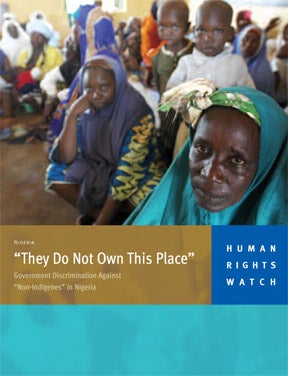
Strangers in their own land
Government Discrimination Against “Non-Indigenes” in Nigeria
http://hrw.org/reports/2006/nigeria0406/
The population of every state and local government in Nigeria is officially divided into two categories of citizens: those who are indigenes and those who are not. The indigenes of a place are those who can trace their ethnic and genealogical roots back to the community of people who originally settled there. Everyone else, no matter how long they or their families have lived in the place they call home, is and always will be a non-indigene.
The concept of “indigeneity”—the idea that there is a meaningful distinction to be made between “host” and “settler” communities—is not entirely an artificial construct. Nigeria is a nation of more than 130 million people, but many Nigerians belong to ethnic communities so small that they fear being absorbed into the larger populations around them and losing control of their identity as a community. The distinction between indigenes and non-indigenes may help to guarantee Nigeria’s more than 250 ethnic groups the power to preserve their unique identities—their culture, traditions and traditional institutions of governance—by maintaining some cultural distance between themselves and other Nigerians.
This rationale, however, has been twisted beyond recognition by state and local policies, often unsupported by any law or other form of legal justification, that marginalize and exclude non-indigenes in ways that have nothing to do with the preservation of cultural identity and autonomy. As a matter of government policy, many states refuse to employ non-indigenes in their state civil services, and most if not all of Nigeria’s thirty-six states deny them the right to compete for academic scholarships. State universities generally discriminate against non-indigenes in their admissions policies and charge higher fees to non-indigene students who do manage to secure admission. Non-indigenes must also contend with a range of less formal discriminatory practices, such as barriers to political participation and discrimination in the provision of basic services and infrastructure to their communities, that government does nothing to stop or even discourage. All of these practices have been made more harmful—and become more controversial—by increasing levels of chronic poverty throughout Nigeria.
Taken as a whole, these discriminatory policies and practices effectively relegate many non-indigenes to the status of second-class citizens, a disadvantage they can only escape by moving to whatever part of Nigeria they supposedly belong in. But many Nigerians have no real ties to the regions they are said to originate from, and feel that they should have some way of becoming full citizens of the places they call home. Worse still, Nigeria is home to communities of people who are discriminated against as non-indigenes even though their families have occupied their land for a century or more and no longer have any idea where their ancestors migrated from. A Nigerian who cannot prove that he is an indigene of somewhere by producing a “certificate of indigeneity” is discriminated against in every state of the federation and is barred from many opportunities at the federal level as well.
Nigeria’s federal government has done nothing to curb this state and local discrimination against non-indigenes, even though it makes a mockery of the Nigerian Constitution’s guarantee of freedom from discrimination. While high-ranking federal officials including even President Olusegun Obasanjo have publicly denounced the growing negative impact of Nigeria’s indigene/settler divide, federal government policies have served to reinforce and legitimize its consequences.
In addition to their direct human impact on the lives of non-indigenes, these discriminatory policies have served to aggravate intercommunal tensions that are dangerously volatile in and of themselves. After more than four decades of disastrously corrupt and unaccountable governance, the benefits that are meant to go with Nigerian citizenship are in desperately short supply. As poverty and unemployment have both become more widespread and more severe in Nigeria, competition for scarce opportunities to secure government jobs, higher education and political patronage has intensified dramatically. Many Nigerians believe that this desperate competition between citizens for some basic level of economic security lies near the heart of most of the country’s intercommunal conflicts. As the secretary general of Nigeria’s Catholic Secretariat put it, “Poverty in Nigeria has assumed the moral character of war, and this is what you see reflected in much of the ethnic violence in this country.”1
Against this background of scarcity and competition, disagreements over who are and are not entitled to call themselves indigenes have been made more intense and ultimately more violent by the increasingly burdensome economic consequences of losing the debate. Perhaps just as important, government policies that enhance the importance of indigeneity have heightened intercommunal divisions because they have served to erode the very meaning and importance of national citizenship, subordinating it in many respects to Nigerians’ ethnicity and ancestry. Indeed, in many important respects state and local governments treat their non-indigene constituents like citizens of a foreign country.
By failing to exercise leadership on the indigeneity issue, the Nigerian federal government has turned a blind eye to violations of some of the most fundamental rights guaranteed to its citizens by the Nigerian Constitution and international human rights law. Human Rights Watch calls on the Nigerian government to signal a clear departure from this shameful record by sponsoring, publicizing, and then enforcing legislation that places clear limits on the kinds of distinctions that can be made between indigenes and non-indigenes and expressly outlaws the harmful discriminatory practices described in this report.
This report is based largely on a six-week Human Rights Watch research mission to Nigeria in late 2005 that included field research in Kaduna, Kano, Plateau and Delta states as well as interviews in Abuja, Lagos and Ibadan. During the course of that mission, Human Rights Watch conducted interviews with a broad range of individuals including government officials, civil society activists, community and youth leaders, victims of indigeneity-related discrimination, and individuals who had participated in violent conflicts between indigene and settler communities.
read full report
Nigeria discrimination condemned
http://news.bbc.co.uk/1/hi/world/africa/4943700.stm
Millions of Nigerians are being treated like second-class citizens because they cannot prove their roots lie in the area where they live, a report says.
Lobby group Human Rights Watch says state governments regularly deny access to jobs and basic services to people seen as non-indigenous.
This official discrimination helps fuel ethnic and religious conflict, it says.
There are more than 250 ethnic groups in Nigeria. Thousands have been killed in communal clashes since 1999.
As Nigerians have migrated around the country, their origins have become a major social and economic issue.
If a person cannot prove they are descended from the original settlers of the area where they live, they're categorised as "non-indigenes".
It does not matter if their family has lived in the area for more than a century.
HRW says state and local governments regularly deny non-indigenes access to government jobs, academic scholarships, even access to basic services.
An elderly Hausa resident of Zangon-Kataf in southern Kaduna said his family had lived there for 200 years but he still faced harassment and violence.
Their homes were burnt to the ground in 1992.
"Our parents were born here and we ourselves were born here. We know no other place other than here and so we have nowhere else to go," he said.
Sand clashes
The author of the report, Chris Albin-Lackey, says the discrimination is often driven by local leaders, seeking to divert blame for their own failings.
"By denying non-indigenes access to certain economic and educational opportunities, they're seeking to curry favour with their indigene constituents," he says.
"At the end of the day it's really a failure of leadership on the part of the federal government that has allowed all of this to happen."
Human Rights Watch says this discrimination helps fuel ethnic and religious violence, as poor communities struggle over control of resources.
Just two weeks ago in central Nigeria, there was a dispute over whether a non-indigene had the right to take sand from a river bed to build a house.
It sparked clashes which left more than 20 people dead.
Human Rights Watch says the federal government must legislate to end the discrimination.
Changing ingrained attitudes on the ground, though, could prove more difficult.
Wednesday, April 26, 2006
Oil for the Lamps of China
The title is taking from the 1935 film 'oil for the lamps of china'
China and Nigeria agree oil deal
http://news.bbc.co.uk/1/hi/business/4946708.stm
China has secured four oil drilling licences from Nigeria as President Hu Jintao continues his week-long tour of Africa, his second in three years.
In exchange China will invest $4bn (£2.25bn) in oil and infrastructure projects in Nigeria.
China will buy a controlling stake in Nigeria's 110,000 barrel-a-day Kaduna oil refinery and build a railroad system and power stations.
Nigeria, Africa's top oil exporter, has long been viewed by China as a partner.
The Chinese interest in Africa is welcome but we need to 'shine our eyes well well' (like my peeps will say) This time around the relationship has to be of mutual benefit. (No giving away of the family heirlooms for a mirror or was it for religion??)
There's a saying 'beware of greeks bearing gifts', As long as we Africans are aware that there's no free lunch and we ensure that we actually gain something from the relationship rather than letting China use us as a source of cheap raw materials.
The Chinese are unlike the west, in the sense that they just want to do business and do not really care about who they do business with. China has a policy of not interfering in the internal politics of other countries so its unlikely they'll have any qualms about Obj's third term 'politricks'.
I suppose what concerns me about China apart from not caring who they do business with, is what they intend to do with their growing economic and political power. China today is like a sleeping tiger, as regards to its political and military clout. One day it will wake up to this reality and show its teeth, so until we know what they are really up to 'make we shine eye well well o'
Quote: Behind every successful man there are a lot of unsuccessful years - Bob Brown
Wednesday, April 19, 2006
Dance with my father
The Luther Vandross song Dance with my father has been playing in my head all day. Its been exactly 2 years since my father died and yet it feels as if it happened not too long ago.
Never dreamed that he would be gone from me
If I could steal one final glance, one final step, one final dance with him
I'd play a song that would never, ever end
'Cause I'd love, love, love
To dance with my father again
I never danced with my father but i can relate to the song, as its all about a son missing his father and the time they spent together.
Quote: 'Elephants are never tired of carrying their tusks' - anon
get involved by sponsoring an African child today:
http://www.plan-uk.org/wherewework/westafrica/
Tuesday, April 18, 2006
The Political Importance of Diasporas (referenced article)
http://www.migrationinformation.org/Feature/display.cfm?ID=313
By Steven Vertovec
University of Oxford
Over the past 25 years, diasporas have increasingly become significant players in the international political arena.
Examples of such politically active diaspora communities are the Jewish-, Greek-, Cuban- and Armenian-American associations that represent some of the strongest lobbies in Washington, DC. Diasporic Iraqi groups and individuals played crucial roles in encouraging American military intervention in Iraq in 2003.
Many countries, such as Israel and Armenia, regard their diasporas as strategically vital political assets, while others, such as India, the Philippines, and other migrant-sending countries, have been recognizing the massive contributions their diasporas make through remittances.
There are many reasons why, over the past few decades, such diasporas have become more prominent on the world stage. New communication technologies have improved abilities to mobilize, and multiculturalism policies in receiving countries have revitalized ethnic pride and assertiveness.
Also important are the growth of economic resources due to swelling migrant numbers, and the profound changes in the world political system itself as more democratic nation-states emerged following the fall of communist regimes.
In a range of policy areas today — including foreign affairs, economic development, and international migration — the place of diasporas increasingly needs to be considered.
Contested Definitions
"Diaspora" is a word of Greek origin meaning "to sow over or scatter." Until fairly recently, the historical Jewish experience provided the archetype: forced expulsion and dispersal, persecution, a sense of loss, and a vision of return.
Over the past decade or so, however, "diaspora" has become a term of self-identification among many varied groups who migrated or whose forbearers migrated from one place to another or to several other places.
Observable in a multitude of websites (a Google search gives close to four million hits for "diaspora"), most self-described diasporas do not emphasize the melancholy aspects long associated with the classic Jewish, African, or Armenian diasporas. Rather, they celebrate a culturally creative, socially dynamic, and often romantic meaning.
For example, one Indian diaspora website states, "The Diaspora is very special to India. Residing in distant lands, its members have succeeded spectacularly in their chosen professions by dint of their single-minded dedication and hard work. What is more, they have retained their emotional, cultural and spiritual links with the country of their origin. This strikes a reciprocal chord in the hearts of people of India."
Also, any longed-for return to the homeland now tends to be downplayed in favor of ideological identification or transnational practice that can link the scattered community with the homeland. Today, self-defined diasporas tend to find esteem — and a kind of strength-in-numbers — through using the term.
This shift in the adoption and meaning of "diaspora" has undoubtedly caused some confusion and stimulated debate. In a burgeoning body of literature, academics across the humanities and social sciences often disagree on contemporary definitions of "diaspora," its typical reference points, characteristic features, limits, and social dynamics.
Critics of the term "diaspora" object to the ways it may suggest homogeneity and a historically fixed identity, as well as values and practices within a dispersed population. And who decides who belongs, and according to what criteria? Is it normally based on original nation-state, religion, regional, ethno-linguistic or other membership criteria? Is descent the only defining condition of membership — and for how many generations after migration does membership last?
In order to have real meaning, claims and criteria surrounding diasporic boundaries and membership should be self-ascribed. It seems illegitimate for others to decide if a person is part of a diaspora if she does not regard herself as part of such a group.
Belonging to a diaspora entails a consciousness of, or emotional attachment to, commonly claimed origins and cultural attributes associated with them. Such origins and attributes may emphasize ethno-lingustic, regional, religious, national, or other features. Concerns for homeland developments and the plight of co-diaspora members in other parts of the world flow from this consciousness and emotional attachment.
Such a definition cuts through questions around the number of generations passed, degree of linguistic competence, extent of co-ethnic social relations, number of festivals celebrated, ethnic meals cooked, or style of dress worn. That is, just "how ethnic" one is does not affect whether and to what extent someone might feel themselves part of a diaspora.
With such an understanding, we can appreciate how diasporic identification may be lost entirely, may ebb and flow, be hot or cold, switched on or off, remain active or dormant. The degree of attachment — and mobilization around it ? often depends upon events affecting the purported homeland.
Natural disasters, conflicts, and changes of government tend to bring out such attachments. For example, the Asian tsunami in December 2004 mobilized Sri Lankan, Indian, Thai, and Indonesian groups abroad (see related article).
Actual exchanges of resources or information, or marriages or visits take place across borders — between members of a diaspora themselves or with people in the homeland — are transnational activities. To be transnational means to belong to two or more societies at the same time. At that moment, the diaspora functions as a transnational community.
When such exchanges do not take place (sometimes over many generations), but people maintain identification with the homeland and co-ethnics elsewhere, there is only a diaspora. In this way, not all diasporas are transnational communities, but transnational communities arise within diasporas.
Today, technology makes it far easier for groups to function as transnational communities for identity maintenance and political mobilization. In particular, cheap air travel and phone calls, the Internet, and satellite television have made staying in touch affordable. Indeed, the proliferation of diaspora-related websites testifies to the strength of common interests and identity.
Diasporic identifications may be multiple, too, depending on the criteria used. The same individual may consider herself to be part of a global Hindu population or a dispersed community of Swaminarayanis (sect), Indians (nation-state), Gujaratis (state or language), Patidars or Patels (caste and sub-caste), Suratis (dialect and region), or villagers. These do not rule each other out. Moreover, any one of a person's identities may be dormant or active transnationally.
Finally, in conceiving diasporas we should resist assumptions that views and experiences are shared within a dispersed population despite their common identification. This is especially the case among diasporas of people who migrated at different historical junctures.
Awkward encounters or serious intra-diaspora conflicts tend to arise as new waves of migrants meet people of previous waves who preserve bygone traditions or who left with greatly differing political views and circumstances. Vehemently anti-Castro, pre-1962 Cuban ?migr?s may clash with Cuban migrants who are "children of the Revolution."
Sometimes, there is a lack of communication and interaction when an earlier wave of migrants comes from a different social or economic class than a later wave. For example, a previous generation of migrants may have had very limited communication with, or knowledge about recent events in, the homeland although they still have ethnic pride. They may have little in common with a fresh wave of highly politicized refugees or exiles who are wholly absorbed with cultural and political changes in the homeland.
Conversely, to the embarrassment or dismay of new migrants, the well-established diaspora communities in the destination country might promote "long-distance nationalism" and believe in some of the most right-wing and reactionary forms of ethnic exclusivism and patriotism.
Diaspora Politics
Political interests and activities within diasporas are certainly nothing new. Historical studies of migrant communities indicate the considerable degree of political engagement-from-afar evident at least 100 years ago.
At present, we can broadly observe a variety of ways — many similar to these historical forms — in which internationally dispersed social groups mobilize and undertake a range of electoral and non-electoral political activities.
Different diaspora-based associations may lobby host countries to shape policies in favor of a homeland or to challenge a homeland government; influence homelands through their support or opposition of governments; give financial and other support to political parties, social movements, and civil society organizations; or sponsor terrorism or the perpetuation of violent conflict in the homeland.
Global networks of diaspora associations sometimes engage in mass protest and consciousness-raising about homeland-related issues. Following the 1999 capture of Kurdish leader Abdullah Ocalan, organized mass demonstrations among Kurds took place in dozens of localities around the world, bringing Kurdish issues to worldwide attention.
Homeland nation-states themselves may reach out to engage the political interests of diaspora populations. Making provisions for dual citizenship and/or nationality is one way for countries to reach migrants. There is now an upward global trend in the prevalence of dual citizenship/nationality, both in terms of people possessing it and states allowing it.
It is estimated that more than a half-million children born in the United States each year, who are American citizens automatically, have at least one additional nationality. Of course, many policymakers in migrant-receiving countries are unhappy about this, believing that people should only have allegiance to one flag and loyalty to one state.
In migrant-sending countries, dual citizenship sometimes has been difficult to push through governments since domestic politicians tend to see the disadvantages. They often feel that "absentee" voting might give too much influence to people living outside the country.
Indeed, expatriate votes are of concern to many countries with sizable diasporas. This was recently felt during the Iraqi election in January 2005, when over one million Iraqi expats were expected to have a major impact on results. In fact, only one-fourth of those eligible actually registered to vote.
Other cases demonstrate how overseas nationals may return home en masse to participate in elections, which has happened in Turkey and Israel, sometimes with political parties paying for flights. Migrants also may vote in large numbers at overseas embassies, as during recent Indonesian and Algerian elections.
The weight of diaspora interests and support sometimes leads to special forms of representation in governments or dedicated ministries for diasporas. A prime illustration of diasporic political payoff occurred in 1990 when Croatians abroad donated $4 million towards the election campaign of Fanjo Tudjman and were subsequently rewarded with representation in parliament: 12 of 120 seats were allotted to diaspora Croats ? more than allotted to Croatia's own ethnic minorities.
The money diaspora populations send home is highly sought by many countries (developing or not). Hence, numerous governments now offer their nationals abroad special foreign currency accounts, incentives or bonds for expat investment, customs or import incentives, special property rights, or privileged access to special economic zones.
To keep the diaspora politically interested as well as to sustain financial flows, politicians in countries of emigration often invoke solidarity among their expatriate nationals. This was exemplified in 1990 when Irish President Mary Robinson proclaimed herself leader of the extended Irish family abroad.
During Vincente Fox's campaigning among Mexicans in California in 2000, he similarly played upon the broader boundaries of an imagined nation by declaring he would be the first president "to govern for 118 million Mexicans" — including 100 million in Mexico and 18 million living outside the country.
And in his inaugural speech in 2002, Kenyan president Mwai Kibaki appealed to all Kenyans abroad "to join us in nation-building."
Nation-Building and Wrecking
History provides many examples of nation-creation projects fashioned in exile; Garibaldi, Lenin, Gandhi, and Ho Chi Min all spent time abroad. Leaders of several "stateless diasporas" — Kurds, Kashmiris, and Sri Lankan Tamils among them ? struggle towards such projects today.
Diasporas play an increasingly significant part in the development of nation-building in poor countries and in ones which have undergone major transformation, such as Eastern European and former Soviet states. This is due to a number of factors, including access to economic resources, greater ease in communication and travel, and the large number of expatriate professionals and entrepreneurs who have skills and experience to offer.
The foremost means of diasporic nation-building comes through individual remittances, followed by hometown associations and charitable initiatives that directly affect economic development, poverty reduction, and capacity building. Governments of migrant-sending and receiving countries, international agencies, and academics are now paying considerable attention to the relationship between diasporas and development.
Another, related field gaining notice concerns the potential diasporas have for reducing brain drain in developing countries. Innovative national and international programs for "tapping the diaspora" have been put in place so that home countries can access expatriate expertise, knowledge, and experience (as well as external networks for trade, communications, and technological development).
One of the best known is the UN Development Program's Transfer of Knowledge through Expatriate Nationals (TOKTEN), which began in Turkey in the 1970s and is now established in some 50 countries. The program supports thousands of emigrant nationals with professional expertise to return to their countries of origin and work for a few weeks or months, though some choose to stay longer.
Another mode of nation-building, or at least maintenance, comes through disaster relief. There are many examples of substantial aid flowing from diasporas following catastrophes such as Hurricane Mitch in Central America in 1998 and the earthquakes in Turkey in 1999 and in the Indian state of Gujarat in 2001. Diaspora groups relevant to areas throughout the Indian Ocean responded generously to the December 2004 tsunami, as mentioned earlier.
Yet even where such humanitarian responses arise, corrosive diaspora politics may be present. According to reports, diaspora aid to Gujarat after the 2001 earthquake served to sustain anti-Muslim pogroms. There have been claims that various Tamil organizations collected money for Sri Lankan tsunami victims that was in fact used for weapons and materials for the Liberation Tigers of Tamil Eelam (LTTE).
Diasporas can also actively be involved in nation-wrecking when there is violence and war in the homeland. Diasporic groups have played major roles in fomenting and supporting conflict in places as diverse as Ethiopia, Kosovo, Nagorno-Karabakh, Kashmir, Israel, and Palestine.
Financial support may flow from various parts of a diaspora to insurrectionist groups or a particular government's efforts to eradicate them. When this is an interethnic conflict, two or more diasporas might be pitted against each other, as was evident in the break-up of Bosnia.
Diasporas may take part in efforts to resolve conflict and to sustain post-conflict reconstruction, such as in Eritrea and Sri Lanka. But with the money they send home, they can increase the risk of renewed conflict in the years immediately following an upheaval, according to a World Bank Report.
Conclusion
Even though they reside outside of their or their parents' home countries' borders, many people regard themselves as legitimate members of its collective identity and socio-political order.
But diasporic identities and activities tend to have differential implications for homelands and host countries.
For host countries, the dual political loyalties suggested by diasporas may raise fears of "enemies within" and terrorist sleeper cells. Such suspicions can feed into racism and other forms of discrimination.
A further question with social and policy importance arises in host countries: does diasporic attachment — passive or active — hinder immigrant integration? Some argue that immigrants will never truly integrate if they are constantly looking "back home." Others say that only by maintaining strong ethnic and transnational bonds can migrants build the confidence they need to successfully incorporate themselves.
With regard to their national diasporas, homelands certainly want remittances and may appreciate lobbying, but they may resent too much political involvement. That is why some offer limited forms of dual nationality without extending too much by way of voting and parliamentary representation.
With regard to all these dimensions of diasporic political impact, diversity within diasporas must be stressed. In any case of lobbying, charitable donation, or conflict support, "the diaspora" rarely acts as one. Most diasporas, whether based on ethno-linguistic or national criteria, include opposing factions and dissenting voices. These, however, are often muffled by better organized, networked, and financed actors, who are often the ones pushing nationalist or ethnic agendas.
Diasporas powerfully embody broader trends in the changing nature of nation-states. Today, national/ethnic identification, political community, and place of residence do not automatically fit together neatly.
Instead, migrants have multiple attachments that modern technology has facilitated. Their political identities and practices are shaped between and within the contexts of both migrant homelands and host societies.
This is an irreversible trend that policymakers should be conscious of when reconsidering any adjustments to immigration and integration policies. We cannot expect today's migrants simply to cut their roots.
Steven Vertovec is Professor of Transnational Anthropology at the University of Oxford and Director of the British Economic and Social Research Council's Centre on Migration, Policy and Society (COMPAS).
Sunday, April 16, 2006
Bodies Exhibition
The controversial bodies exhibition hit London this week, shame they wouldn't allow any pictures of the exhibits.
The exhibition is quite similar to Gunther von Hagens BodyWorlds which i saw at Brick lane some years ago.
Great exhibit, definitely worth seeing (worth the price just to see what the lungs of a cigarette smoker looks like)
Thursday, April 13, 2006
A Political Minefield
Immigration has turned into a political minefield in the UK. The government is introducing all sorts of laws to stem the inflow of illegal immigrants, unfortunately as the Home office found out this week, some of the tough new laws breach human rights.
Sham marriage law breaches rights
http://news.bbc.co.uk/1/hi/uk/4894544.stm
Tough government rules to prevent sham marriages discriminate against immigrants, the High Court has ruled. In a significant defeat for the government, Mr Justice Silber said the rules were unreasonable and breached human rights.
Campaigners said the law was discriminatory because it effectively labelled some immigrants as fraudsters.
The judge gave leave to appeal - but the Home Office has partially suspended the rules while it considers its case.
SNIP
The rules, introduced in February 2005, mean people born outside the EU and some bordering European nations who have only six months' permission to be in the UK must seek special permission from the Home Office to marry, irrespective of the status of their partner.
Another story that caught my attention.
Ship's stowaways 'facing death'
http://news.bbc.co.uk/1/hi/england/essex/4905848.stm
A group of suspected illegal immigrants who had been in a container for nearly three weeks were "saved from death" by sharp-eared dock workers.
The four men were found at Tilbury Docks in Essex after the container was unloaded from a ship.
Essex Ambulance Service said the four were in squalid conditions and three found to be badly malnourished.
The container was to be stored and an ambulance spokesman said they could have died if they had not been heard.
Dockers were alerted to the plight of the men when they heard cries from inside a container.
Ambulance service manager, Steve Brant, said: "We understand the container had come from Nigeria and was due to stand in Tilbury for a period before being shipped out to Amsterdam.
Initially i thought they were escaping from some war ravaged country, so imagine my surprise (or shock?) that they were from Nigeria. Now, i understand things are tough over there but trying to get in to the UK this way is definitely not worth the risk. They would have died if no one found them.
which brings me to the drama i was talking about in a previous entry . I've never had any personal experience of the humiliation a lot of Nigerians go through while applying for an entry visa to the UK (since i was born here).
My baby sister has been a university student here in the UK for the past few years. She came in to the UK on a student visa and decided to apply for a working holiday visa when she finished her course last month.
The rules state you have to return to your home country to apply for any change to your existing visa. So she returned to Nigeria and applied to the British High Commission.
Her application was declined (to use their parlance)
I'm aware the UK government is trying to discourage illegal immigration, but when you tell people to follow the rules, you can't then turn around and change those rules or come up with ridiculous reasons to try and get round them.
My sister's application was turned down based on the entry officers' view that she may not return to Nigeria when her visa runs out. This was complete bullshit as she returned to Nigeria to reapply for the visa when she could have stayed in the UK and extended her student visa.
what happened to the British concept of fair play ?
I was livid, and when i'm in such a mood i do what i do best, so i fired off a series of letters to the High Commission and the Foreign office. Hell i'm not going down like that, I'm one Nigerian who knows how to fight.
Luckily, it seems they realised their mistake and called her back a few days later to give her the visa. (I should have pressed for an apology but i thought i'll be pushing my luck)
But i'm still mad, i think its an outrage the way they treat Nigerians and i can only blame the spineless government we have. A government that seems incapable of protecting the rights of its citizens. Last year when the UK government introduced restrictions on Nigerians between the ages of 18 and 30, our government did nothing about it.
I expected the Nigerian government to retaliate by introducing tough measures against British nationals, especially the expatriate workers in the oil industry.
Some may argue that retaliatory actions against British interests/nationals may be counter productive, i say fuck that. Like Jimmy Cliff sang in the 'Harder they come' 'I'd rather be a free man in my grave than living as a puppet or a slave'
During Abacha's rule when the British government banned Nigeria airways from flying to the UK, Abacha did the same to British Airways. BA was begging and lobbying the British government to rescind the ban as it was losing a lot of money.
Nigeria will definitely regain its lost glory and we'll never forget the way our "commonwealth friends" treated us.
Quote: 'The man who follows the crowd will usually get no further than the crowd. The man who walks alone is likely to find himself in places no one has ever been.' - anon
get involved by sponsoring an African child today:
http://www.plan-uk.org/wherewework/westafrica/
Tuesday, April 11, 2006
Hey Abbott
Diane Abbott , British MP for Hackney (in East London) recently wrote an article Think Jamaica is bad? Try Nigeria for the Jamaican observer.
she wrote (and i quote)
"Yet, in certain crucial aspects Nigeria is in an even worse position than little Jamaica, and contemplating the Nigerian situation might cause even the gloomiest Jamaican talk show host to count their blessings."
oh and another gem from the article
"And when it comes to corruption, Nigerians make Jamaicans, and every other nationality in the world, look like mere amateurs."
Then to round it up she says "Jamaica has some problems, but people who want to dub it a 'failed state' should look more carefully at other countries in the developing world with far more serious social, political and economic problems."
Ok i'm not going to defend Naija here as we know say we get problem, but who is Diane Abbott to point fingers, lets not even talk about her own hypocrisy, from failing to declare payments for tv work to parliament or for sending her son to a private school while criticising others for doing so
but i digress
Comparing Jamaica a country of 2.7 million to Nigeria a country made up of over 110 million people and 250 ethnic groups, is quite an interesting way of consoling herself that Jamaica is doing 'alright'
For a nation of 2.7 million, Jamaica sure has a lot of problems (for such a 'small' country).
According to jamaica-gleaner.com "Over the past two decades, Jamaica has experienced an unparalleled increased in homicides and violent assaults. Many attempts made throughout the years to reduce the number of violent crimes occurring in the island have mainly been short-term measures, aimed predominantly at increasing Police mobility and firepower and have ultimately proved to be unsustainable."
According to the US State dept, "High unemployment--averaging 15.5% rampant underemployment, growing debt, and high interest rates are the most serious economic problems. Violent crime is a serious problem, particularly in Kingston."
It also points out that "Jamaica is a major transit point for South American cocaine en route to the United States. It is also the largest Caribbean producer and exporter of marijuana. A significant increase in cocaine flow through Jamaica was observed during 2001. Jamaica is the embarkation point for the largest number of passengers arrested on drug charges at U.S. airports."
According to the UK Observer, "A UN report condemned Jamaica's record on human rights and extra-judicial killings by the police. An average of 140 people have been shot dead every year of the past decade in a country of 2.6 million. In the capital Kingston, the murder rate is the third highest in the world"
I could go on but i will stop here for now.
I find it extremely disappointing that instead of writing articles that will promote unity between Africans and Caribbeans, she chose to write articles that will further divide our communities.
Next time she should try comparing like for like, like comparing Jamaica to other Caribbean countries and lets see how well it comes out.
Ms Abbott, people who live in glass houses should not throw stones....
Is Dianne Abbot (MP) A Friend Of Nigeria? By Uche Nworah
She is a successful black woman no doubt, a role model of sorts for most black women in the UK. Undeniably she has already secured her place in the history of UK politics as the first black woman to be elected into the UK parliament. She represents Hackney North and Stoke Newington constituency, one of the poorer districts in inner London.
This daughter of immigrant Jamaican parents rode on the back of the ‘black vote’ to victory in 1987, by her own admission she owes much of her success to the support of Nigerians resident in her constituency. She was quoted to have remarked thus: “Nigeria has a very special place in my heart and I have so many friends there. My constituency in Hackney, East London, has the largest Nigerian population anywhere in the UK”. These remarks from their Member of Parliament (MP) will surely gladden the hearts of Nigerians living in Miss Abbot’s constituency, particularly Nigerians whose entrepreneurship drive the local Dalston market and contribute immensely to the local economy.
It may seem however that the honourable MP does indeed have two faces; the real one has always landed the divorced mother of one son into controversy. Her decision to send her son to the £10,000 a year private City of London School was one of such. She herself later realised the folly of her decision which she described as "indefensible". The controversy caused by her poor morals and leadership by example still haunts her till date. Her actions was seen by many in the UK as hypocritical because majority of her constituents live in poverty and school children attend under-performing and failing public schools, a situation she didn’t create but which she hasn’t really done much to change. According to the UK Guardian newspaper, Hackney North and Stoke Newington is “one of the most deprived areas in London with significant ethnic minority population”.
Dianne Abbot has now also shown Nigerians and by implication her many constituents her true face by her comments in a recent article she wrote for the Jamaican Observer. In that article titled Think Jamaica is bad? Try Nigeria. She attempts a weak comparison between her home country (Jamaica) and Nigeria. Her impressions about Nigeria obviously were formed during a recent visit as part of a UK parliamentary visit, financed obviously with tax payers’ money from the two countries as Nigeria must have committed resources as well towards hosting the delegation.
While Miss Abbott is entitled to her own opinion, it is important also for her to understand that decorum and public etiquette demands that she and her likes learn to make guarded statements, especially when commenting about other countries, especially when her comments (because of her political position) are bound to be either misinterpreted by others, and also if such comments are likely to ignite further the flames of inter-ethnic wrangling, in this case between Nigerians and Jamaicans in the UK, whom if Miss Abbott had bothered to find out do not necessarily enjoy a cordial relationship.
She may have slipped in the article through the back door to be published in her home country with the understanding that it would never come to the attention of Nigerians who generously hosted her during her visit, but she forgot that we now live in a global village and that technology and news wires now direct specific news stories of interests to peoples’ emails and also to other websites as news feeds, which is why her article has come to the attention of Nigerians. She cleverly did not publish the said article on her personal website – www.dianneabbot.org.uk.
Whatever her motives were in writing the article, and irrespective of her relationship to the new Jamaican Prime Minister (Portia Simpson Miller), it is in bad taste to ridicule another sovereign nation and to juxtapose two countries (Nigeria and Jamaica) using biased indices. It is ethically and diplomatically wrong for her to sacrifice Nigeria’s national interests in an effort to improve the ratings and acceptance for the new government in Jamaica. If she was a private individual her opinion wouldn’t have mattered so much but considering that she made the remarks as a serving UK member of parliament who obviously enjoyed the privileges of a sponsored state visit to Nigeria, the least she could have done was to keep her thoughts and reservations to herself, or better still seek clarification and get better information about Nigeria and her people rather than relying heavily on dinner table ‘second hand’ information which do not represent the reality of today’s Nigeria in every ramification.
While Nigerians accept that things are not quite going the way we would all wish, we also believe that our problems can only be solved by ourselves, and with the help of our genuine friends in the international community who also have a mutual stake in our socio-economic well being.
The fact that she failed to notice many of the changes and reforms currently going on in Nigeria in the key economic sectors (no matter how little) and failed to acknowledge such in her article leaves one to assume that she may have other sinister motives.
If she still has any pride and shame left, Miss Abbott owes Nigerians, including the ones living in her constituency an apology for her scathing and hurtful remarks. What she has done amounts to stabbing Nigerians in the back and seemed premeditated to move the hands of Nigeria’s national re-birth backwards.
If only she knew all the efforts Nigerians in their personal capacities are making to reclaim the glory of our country and make her great again, after recently re-joining the world’s international community again following decades of ostracization as a result of the activities of successive military juntas, she wouldn’t have made such remarks.
Maybe she is not aware of the resources being committed by Nigeria and her people towards re-building Nigeria’s image and make her an attractive investment destination once again, we surely need the help of our friends at this moment in our history of which obviously Miss Abbott is not one of them. As we say in Nigeria, with friends like her, who needs enemies?
Whatever her future political plans are, I’m sure that Miss Abbott knows better than to count on Nigerian votes in the future.
Nigerians living in the UK should make their feelings known both to the Nigerian government through the Nigerian High commission in the UK and also to Miss Abbott herself. Her contact details are as follows. www.dianeabbott.org.uk. Diane Abbott (MP) House of Commons London SW1A 0AA, glennc@parliament.uk, telephone: 0207 219 4426, 07947 598 225.
Uche Nworah, a lecturer and brand scholar lives in London.
Hey Abbott Pt 2
Hey Abbott Pt 3
Saturday, April 08, 2006
Power Drama
The powerplay currently happening in naija as regards to OBJ's third term agenda and Atiku's decision to openly oppose his boss makes for some interesting analysis.
My 'drama' offline (which i'll hopefully blog about when things calm down) is also about the abuse of power. What is it that turns man into a monster when he has power over others??
"Power's tendency to corrupt is a function of the work it does in liberating man's worst characteristics. A man feels his power over another more acutely when he breaks the other's spirit than when he wins his respect. To have power over others is to be in a position to deprive them of choices and options, to bend them to one's will, to make use of them."
The last word on Power (from The Guardian Saturday March 10, 2001)
AC Grayling
The greater the power, the more dangerous the abuse - Edmund Burke
Everyone knows Acton's saying about the corrupting power of power. History proves the truth of his observation by offering egregious individual examples, from Nero to Genghis Khan, from Shaka the Zulu to Pol Pot. What is remarkable is how often power in the hands of an unconstrained individual or claque leads to harm. How many examples are there of the powerful reversing the world's entropic tendencies in order to bring peace, succour and comfort to those in need of them? Woefully few.It is a curious and unhappy fact that those who strive to provide these things - aid organisations, charities, individuals hurt into action by the suffering of their fellows - tend themselves to be anything but powerful.
There are plenty of examples of harmful power in the contemporary world. Attention naturally fixes on the likes of Pinochet, Slobodan Milosovic and Robert Mugabe as cases of men resolved to get their own way no matter what. Such men possess political authority, and have command of armies and police forces; but they do not possess tolerance or respect for alternative views. Unless restrained by democratic institutions and the rule of law - exactly what Mugabe is now brushing aside in irritation at the obstacles they present; for as Lucan warned, "if a strong man does not get what he thinks is his due, he will take all he can" - they will have no reason to stop short of threatening, bullying, and finally "disappearing" their enemies.
There are other kinds of power, no less harmful if in different ways. Consider Rupert Murdoch and his influence on the future of the United Kingdom. He owns several of the country's largest-selling national newspapers and a television network, and although he is not British and does not live in Britain, he does not wish to see the United Kingdom join the single European currency. By every logic of economics and history, the United Kingdom must and will do so - the sooner the better, unless it is content to become a minor offshore banana republic on the sidelines of history. Since Mr Murdoch is no fool, it is tempting to wonder whether that is his aim.
The problem is not the existence of power, but its presence in ungoverned hands. "The first principle of a civilised state," said Walter Lippman, "is that power is legitimate only when it is under contract." The application of this principle is obvious as regards a government's power to enforce the laws it passes, and to keep order in its jurisdiction.
Democracy is a contract by which the exercise of such power is kept responsible. But there are less obvious contracts constraining other kinds of power. The power to state an opinion publicly, for example, is subject to the unwritten contract of debate; the opinion can be disagreed with, its supporting arguments challenged, the facts on which it is based checked. This contract has been hard won in the course of modern history, because it is not long since it was fatally dangerous to disagree with the opinions of those in power, whether they were Popes in the Vatican or party secretaries in the Kremlin. In some places, the danger has not yet passed: Afghanistan and China are examples.
Power's tendency to corrupt is a function of the work it does in liberating man's worst characteristics. A man feels his power over another more acutely when he breaks the other's spirit than when he wins his respect. To have power over others is to be in a position to deprive them of choices and options, to bend them to one's will, to make use of them.
Almost any sensibility can quickly decay into finding this pleasurable as well as convenient. How many SS men denied themselves the pleasure of absolute control over others when it was offered? Perhaps history never got the chance to record the heroism that such denial would truly represent.
Unquestionably, to use real power gently and for the good of others is one of the most heroic of virtues; which is why examples of it are so rare.